


We’re genuinely good at beating breast cancer. Five-year survival for Australian women is now 93%, up from 75% in the late 1980s.
But new Compare Club research tells a different story about what happens next. In a survey of 334 Australian women who completed active breast cancer treatment in the past five years, 97% had paid out of pocket for care after treatment ended, 68% had delayed or gone without care because of the cost, and 92% had made some kind of financial sacrifice to cover it.
Treatment has a finish line. The cost of recovering from it doesn't.
Here’s what our research found, at a glance - and remember these are breast cancer survivors, beating a horrific disease to be slugged and over and over in the wallet:
97% have paid out of pocket for post-treatment care; 28% have spent $10,000 or more.
68% have delayed, reduced or gone without care because of the cost.
92% made a financial sacrifice to cover it; most commonly using savings (52%) or a credit card (36%).
51% estimate losing $10,000 or more in personal income since treatment - while still facing the rising cost of ongoing care.
What does it actually cost to live with breast cancer after treatment ends?
For the large majority of survivors, ongoing care isn't occasional; it's routine, and it adds up. In Compare Club's September 2026 survey, only 3.3% of the 334 respondents had paid nothing for post-treatment care.
Table 1: What survivors pay for after treatment ends
Ongoing cost | Share of survivors affected |
|---|---|
Spent $2,500+ in the past 12 months. | Almost 50% |
Spent $5,000+ since active treatment ended. | Over 40% |
Spent $10,000+ since active treatment ended. | 28% |
Delayed, reduced or went without followup care due to cost. | 68% |
The most commonly skipped items were exactly the ones that matter for catching a recurrence early:
prescription medication (25%).
specialist follow-ups (24%).
scans or ongoing monitoring (24%).
This lines up with independent research. A 2024 study of 45,061 people found 44.9% of Australians diagnosed with cancer more than two years earlier had still paid over $1,000 out of pocket in the past 12 months. Separately, BCNA's research found that one in four privately insured Australian women with breast cancer faced out-of-pocket costs above $21,000 in their first five years.
Does Medicare or private health cover you?
Partly, but for most survivors, not nearly as much as you’d think. In Compare Club's survey, only 11% said nearly all their costs were covered by Medicare and private health insurance combined; 53% said they carried a significant share of the cost themselves, or that very few or none of their costs were covered at all.
That's not a criticism of Medicare or private health. Both are designed around treating the disease, and they generally do that well. What they're not built to fund is the years of monitoring, medication, physiotherapy and psychological support that come after, which is where most survivors’ out-of-pocket figures sit.
Does breast cancer treatment affect income long after diagnosis?
Yes, and for many women, the income hit outlasts the treatment itself. Only 4% of survivors in Compare Club's survey reported no effect on work or income at all, and 51% estimate they've lost $10,000 or more in personal income since treatment.
Table 2: Work impact reported
Work impact | Share of survivors |
|---|---|
Delayed returning to work | 34% |
Reduced working hours | 31% |
Took unpaid leave | 21% |
Returned to work before feeling ready | 19% |
Stopped working temporarily or permanently | 14% |
This tracks with prior Australian research. BCNA's 2017 survey found household hours worked were still around 13% below pre-diagnosis levels in the second year after diagnosis; not the first, the second.
How are households actually covering these costs?
Mostly by drawing down what they already have; 92% of breast cancer survivors in Compare Club's survey made at least one financial sacrifice to cover post-treatment costs.
Compare & SaveTable 3: How the cost was covered
Method | Share of survivors |
|---|---|
Used savings | 52% |
Put it on a credit card | 36% |
Borrowed from family | 26% |
Took out a loan | 19% |
Cut back on groceries | 17% |
Accessed superannuation early | 13% |
Fell behind on housing payments | 11% |
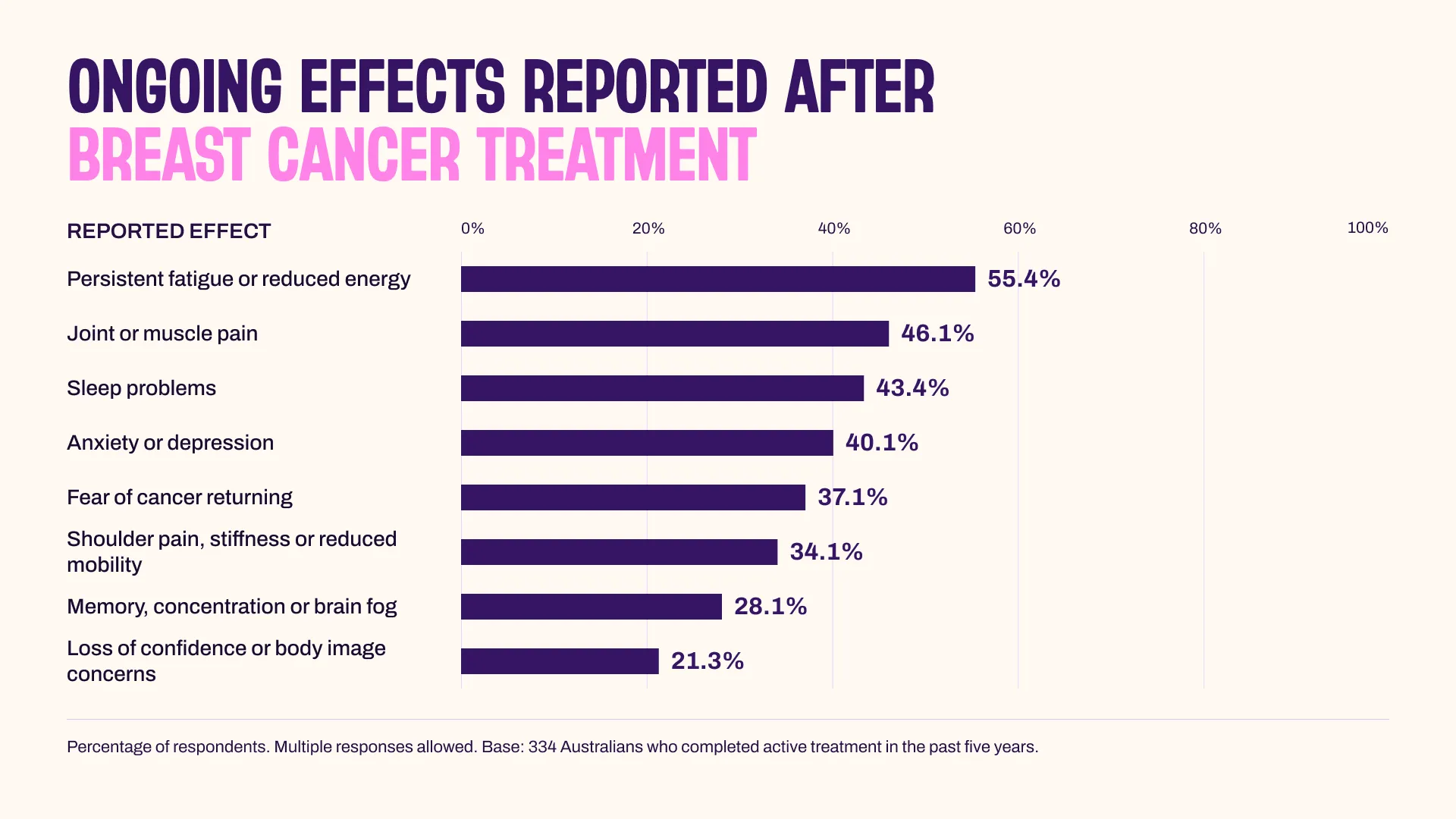
On top of the financial strain, 60% of breast cancer survivors said they didn't feel fully supported once active treatment ended, and 99.7% reported at least one ongoing physical or psychological effect, most commonly fatigue (55%), joint or muscle pain (46%) and sleep problems (43%).
What's trauma cover, and where does it fit into this?
Trauma cover (also called critical illness cover) is a type of life insurance that pays a lump sum on diagnosis of a serious medical condition specified in the policy, such as cancer, heart attack or stroke. It isn't tied to receipts, and it isn't a form of medical treatment or a way to reduce anyone's chance of getting sick.
It's designed to give your household some breathing room during exactly the period this research describes: the years after diagnosis, when the health system's funding drops away but a cancer survivor’s costs don't.
It works differently to the cover most people already have. Default life insurance inside superannuation is typically limited to death and total and permanent disability (TPD) benefits. Trauma cover generally isn't available through super at all. Private health insurance is built around treatment, not the ongoing costs afterwards. A life cover payout goes to a person's family if they die. This doesn't help a survivor cover today's specialist bill.
One thing worth understanding clearly: trauma cover is medically underwritten, which generally means it needs to be arranged before any diagnosis, not after. An insurer decides the terms of any cover, including whether to offer it, and at what price. Nothing is guaranteed, and it isn't a decision to rush; it's one worth understanding while it's still an option.
Compare & SaveSurviving breast cancer in Australia is now the most likely outcome after a diagnosis
Compare Club’s data already shows that surviving doesn't mean the costs just stop. For most of the women surveyed, treatment had an end date, but their bills didn't: 97% paid out of pocket afterwards, 68% went without some form of care because of what it cost, and 51% lost $10,000 or more in income. Understanding what Medicare, private health and any existing insurance actually covers you for - and what they don't - is worth knowing before a diagnosis, not afterwards.
Compare your options
See what trauma cover options may suit your circumstances, compared across our panel of insurers, with final terms set by the insurer after underwriting.
Compare & SaveDisclaimer:
Compare Club Australia Pty Ltd (authorised representative number is 1279036) trading as Compare Club and Advizer Pty Ltd ABN 83 168 993 333 (authorised representative number is 459414) trading as Compare Club Life Insurance, Life Insurance Comparison, and Compare Club Life Pty Ltd are authorised representatives of Alternative Media Pty Limited (AFSL 486326).
Our advice is general in nature which means it does not take into consideration your current objectives, financial situation or needs. Compare Club compares selected products from a panel of trusted insurers and receives commission for this. We do not compare all products in the market. For more information about our services, including how we are paid, please read our Financial Services Guide.


