


Compare Club research among 334 Australians who completed active breast cancer treatment in the past five years found ongoing symptoms, recurring medical bills and lost income were common, with many households forced to make difficult financial trade-offs.
The results show that survivorship often brings a new phase of pressure rather than a clean return to life before cancer. Once surgery, chemotherapy or radiotherapy finishes, people may still be managing medication, pain, fatigue, monitoring and psychological effects. These needs can continue for years, but the associated costs are often less visible and less predictable than the costs of active treatment.
The effects continue after treatment ends
Almost every respondent (99.7%) reported at least one ongoing physical or psychological effect they believed had been caused or made worse by breast cancer or its treatment. Persistent fatigue was the most common, affecting 55.4%, followed by joint or muscle pain (46.1%), sleep problems (43.4%) and anxiety or depression (40.1%).
These effects were not always anticipated. More than two-thirds of respondents (68.6%) identified at least one post-treatment effect they had not expected, with fatigue the most frequently cited surprise.
The findings also point to the cumulative nature of recovery. Fatigue, pain and disrupted sleep can make it harder to work, exercise, attend appointments or manage family responsibilities. Anxiety, fear of recurrence and changes to confidence or body image can add another layer of pressure, even when clinical treatment has been successful.
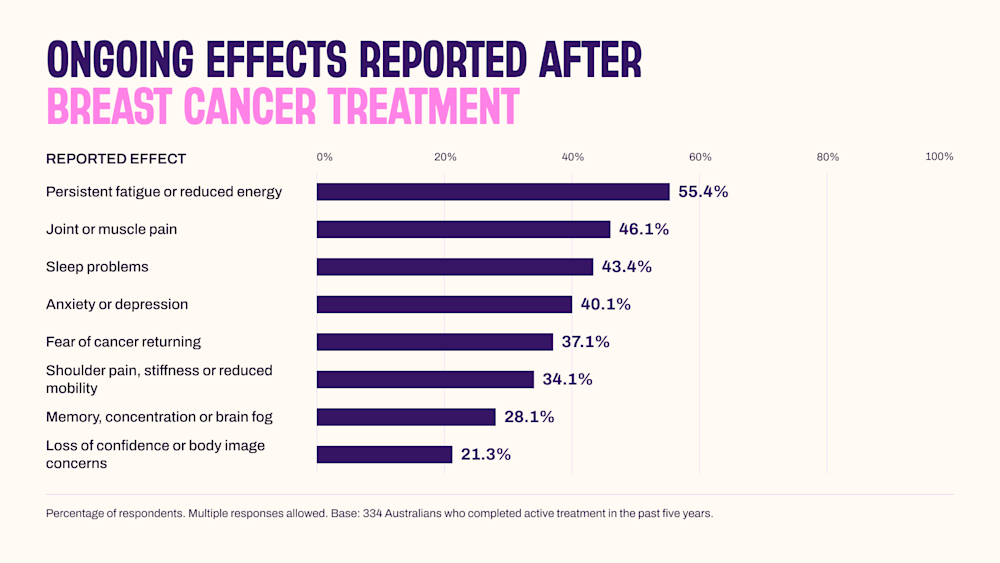
This breadth of experience matters because there is no single post-treatment service that addresses every need. Survivorship support may involve primary care, specialists, allied health, mental health care and ongoing screening. When those services are difficult to access or expensive, people can be left coordinating a complex recovery largely on their own.
A second wave of medical bills
The ongoing effects of breast cancer were accompanied by a long list of recurring expenses. Only 3.3% said they had not personally paid for any post-treatment care. The most common costs were GP appointments (52.1%), specialist appointments (40.1%), prescription medication (36.8%), MRI scans (31.4%) and other scans such as mammograms or ultrasounds (27.8%).
Nearly two-thirds (63.5%) named at least one expense they had not expected to face. Specialist appointments were the most frequently identified unexpected cost, followed by GP appointments and MRI scans.
Many of these are not one-off purchases. Follow-up appointments, prescriptions, scans and rehabilitation can recur over months or years. Smaller gaps and fees may appear manageable individually, but together they can create a substantial and continuing drain on household budgets.
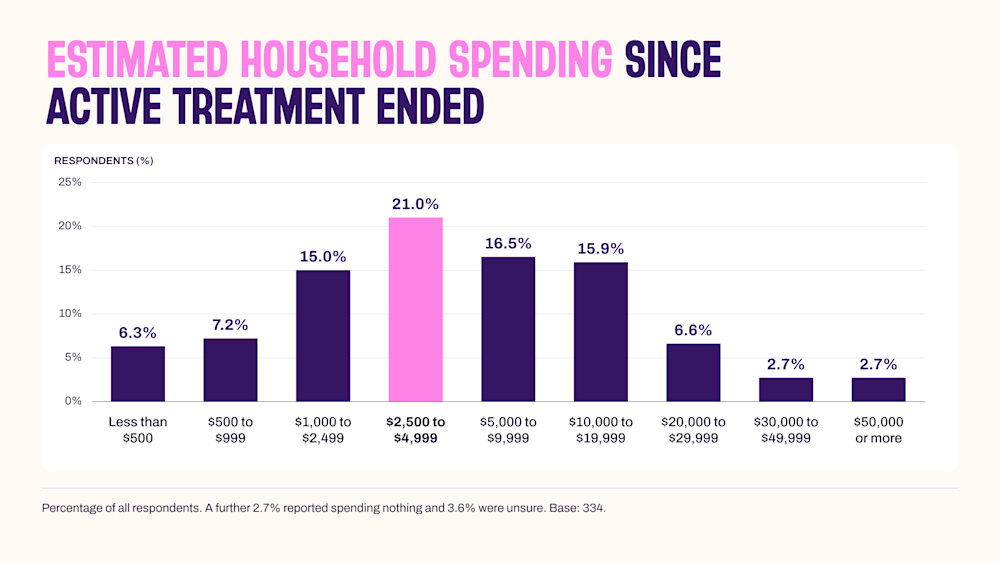
Spending was spread across the full range rather than concentrated in one group. This suggests the financial effect is not limited to a small number of people with unusually complex needs. Even respondents at the lower end of the spending scale were managing costs that sit on top of ordinary household bills and other healthcare expenses.
Costs remain substantial year after year
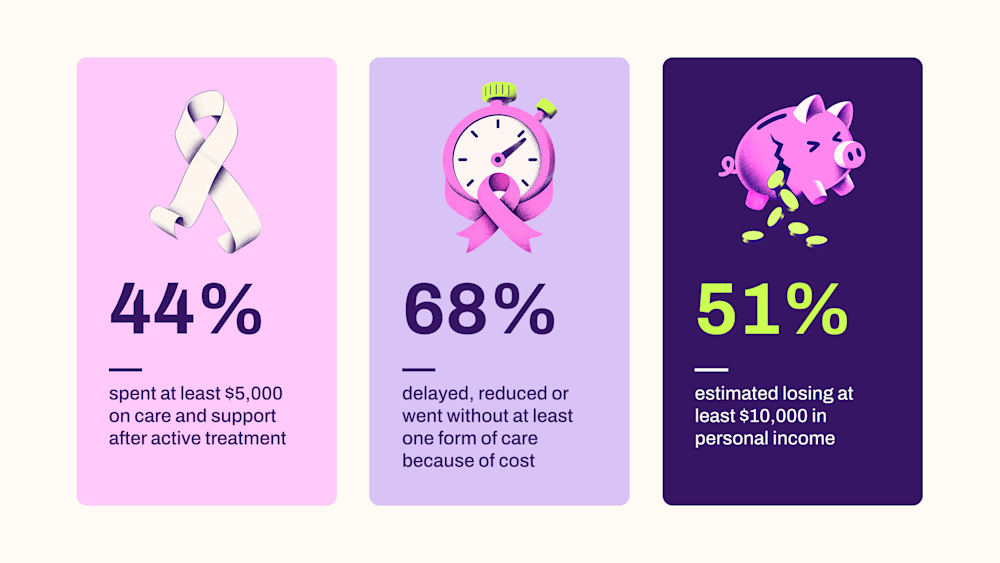
More than two in five respondents (44.3%) estimated their household had spent at least $5,000 on care and support since active treatment ended, including 27.8% who had spent $10,000 or more. The costs were not confined to the period immediately after treatment. In the previous 12 months alone, 68.0% reported spending at least $1,000 and 25.7% had spent $5,000 or more.
For households also dealing with reduced hours, unpaid leave or a delayed return to work, these figures represent a double impact. Money is leaving the household at the same time that earning capacity may be lower, making even predictable follow-up care harder to absorb.
Cover still leaves major gaps
Only 11.4% said Medicare and private health insurance had covered nearly all their post-treatment costs. More than half (52.7%) said only some, very few or none of their costs had been covered, leaving them to pay a significant amount themselves.
Cost also changed the care people received. More than two-thirds (68.0%) had delayed, reduced or gone without at least one form of care. The most commonly affected services were prescription medication (24.6%), specialist appointments (24.0%), scans or monitoring (23.7%), physiotherapy or rehabilitation (19.5%) and psychological therapy or counselling (16.2%).
Delaying this care may not remove the need for it. It can shift treatment further into the future, prolong symptoms or leave people trying to manage without professional support. The result is a financial access problem as well as a healthcare problem.
The financial impact reaches well beyond healthcare
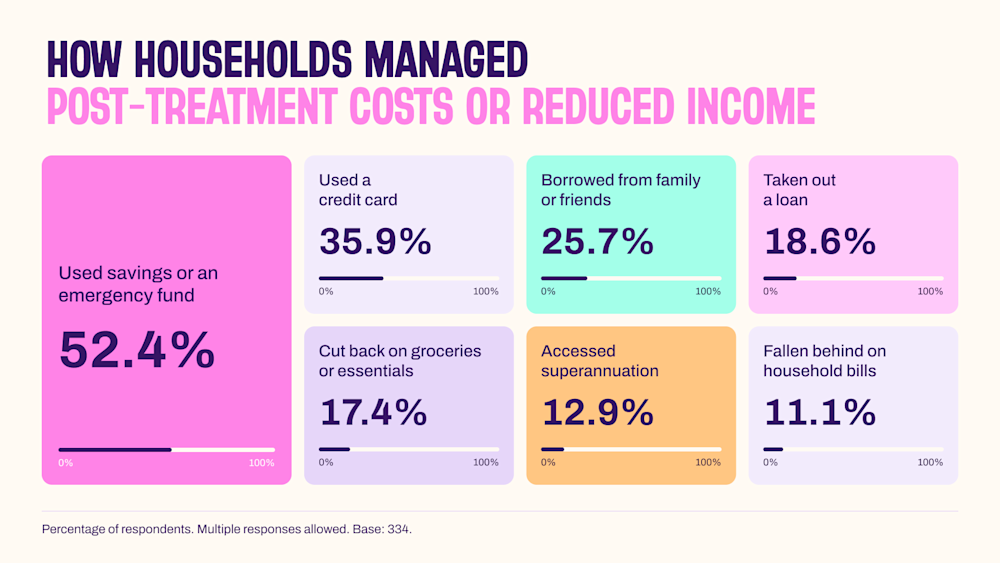
Post-treatment expenses and reduced income flowed directly into household finances. More than nine in 10 respondents (91.6%) reported at least one financial sacrifice. More than half had drawn on savings, more than one-third had used a credit card and one in four had borrowed from family or friends.
These strategies can solve an immediate cash-flow problem, but may create longer-term consequences. Savings take time to rebuild, credit card balances can attract interest and money taken from superannuation is no longer invested for retirement.
Work and income take a lasting hit
Almost nine in 10 respondents (89.2%) reported at least one effect on their work or income, excluding those who said they experienced no effect or were not in paid employment. More than one-third delayed returning to work (34.4%), 30.8% reduced their hours, 21.3% took unpaid leave and 18.9% returned before they felt ready because they needed the income.
The income loss was substantial. More than three-quarters of respondents (77.8%) estimated they had lost at least $1,000 in personal income because of ongoing effects, 50.9% estimated losses of at least $10,000 and 32.0% estimated losing $20,000 or more.
The workplace impact is not only about taking time off for appointments. Fatigue, pain, sleep problems and reduced concentration can affect how many hours someone can manage and whether they feel able to resume previous duties. Some returned before they felt ready because the household could not afford a longer recovery.
Lost earnings and continuing healthcare expenses compound one another. People may need more support precisely when their capacity to pay for it is weakest, while family members may take on additional caring or financial responsibilities.
A preparation and support gap
Only 39.8% felt well informed and prepared for the ongoing health effects and costs they might face. The majority either received incomplete information, were told about possible effects but not their cost, or felt inadequately informed. Six in 10 (60.2%) said support fell away after active treatment, that much of the care and cost was left to them, or that they felt largely unsupported.
People need more than a list of possible symptoms. They also need to understand which services they may require, what Medicare or private health insurance is likely to cover and what they may need to fund themselves. Without that information, it is difficult to plan financially or seek support early.
What the findings show
Breast cancer survivorship is not simply a medical recovery period. For many people it is a prolonged financial challenge shaped by recurring healthcare costs, gaps in cover and reduced capacity to earn.
Better preparation should include clear information about likely effects and costs, practical support to remain in or return to work, and affordable access to ongoing physical and psychological care. Treating survivorship as a distinct stage of cancer care would make this continuing burden more visible and help people plan for what comes next.
About the research: Compare Club surveyed 334 Australians who had completed active breast cancer treatment within the previous five years in September 2026. Of these, 44.6% were still taking ongoing medication or receiving maintenance treatment. Percentages are based on all respondents unless stated otherwise. Multiple-response questions may total more than 100%.


