



Sleep, Secrets & Splurges: The Hidden Cost of Money Stress in Australia
Compare Club Financial Habits Report | October 2026
From sleepless nights and bank balance avoidance to secret spending and relationship breakdowns, new research reveals how financial pressure is affecting Australians' health, habits and relationships.
Australians are doing more than worrying about money. They're losing sleep over it, avoiding their bank accounts, hiding purchases from their partners and, in some cases, watching their relationships fall apart.
Compare Club's October 2026 Financial Habits Survey of 1,000 Australians reveals the extraordinary lengths people are going to as they grapple with financial pressure.
Almost eight in ten respondents (78.3%) have lost sleep worrying about money, while nearly two-thirds (62.7%) admit deliberately avoiding checking their bank balance in the past year because they were worried about what they would find.
The impact extends well beyond household budgets. More than four in ten respondents (43.5%) report that financial stress has worsened their anxiety, while almost half (48.3%) admit lying to a partner or family member about money.
For some, the consequences have been severe, with 6% reporting that an argument about money has permanently ended a relationship.
The research paints a confronting picture of the emotional, psychological and personal consequences of financial pressure.
Key findings at a glance
78.3% have lost sleep worrying about money.
62.7% have deliberately avoided checking their bank balance in the past year.
43.5% say financial stress has worsened their anxiety.
48.3% have lied to a partner or family member about money.
41.9% have hidden a purchase from a current or former partner.
34.9% have pretended to be asleep to avoid discussing money with a partner or former partner.
16.3% say money arguments have resulted in one partner sleeping in another room.
6% report that money arguments have permanently ended a relationship.
1. Too scared to look: Australia's bank balance avoidance problem
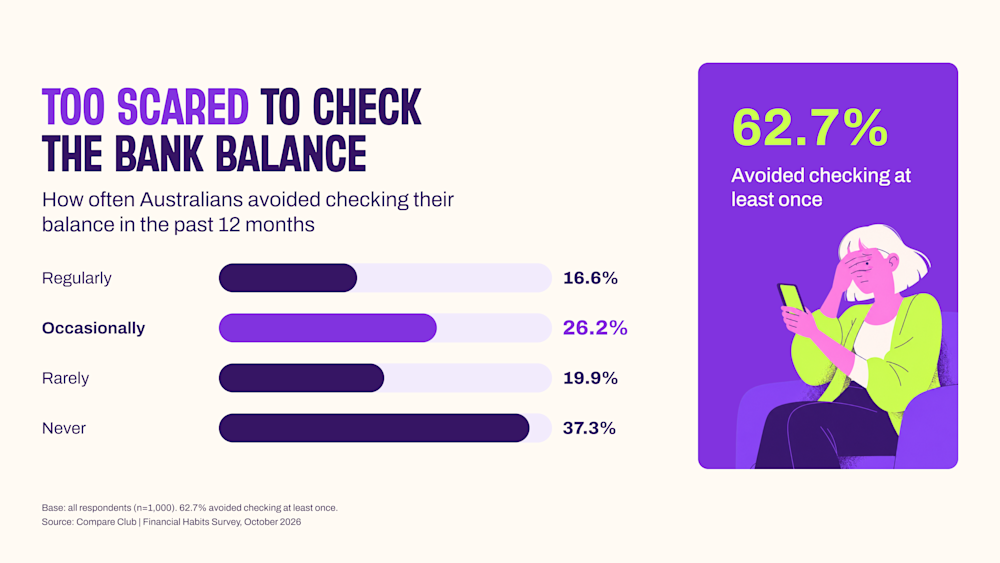
One of the most striking findings is how many Australians are deliberately avoiding their own financial information.
Almost two-thirds of respondents (62.7%) admit they have avoided checking their bank balance at least once in the past 12 months because they were worried about what they might find.
For a significant proportion, this behaviour is more than an occasional occurrence.
Combined, 42.8% regularly or occasionally avoid looking at their bank balance.
The findings suggest that for many Australians, financial stress may be creating a cycle of avoidance. People worry about their financial situation but feel reluctant to confront the numbers.
Kate Browne, Head of Research at Compare Club, says the results demonstrate how confronting household finances have become.
"There's a difference between forgetting to check your bank balance and being too frightened to look.
"When almost two-thirds of Australians admit they've deliberately avoided checking their accounts, it tells us money has become a significant source of stress. The problem is that ignoring your finances doesn't make the bills disappear. It can also mean missing opportunities to reduce what you're paying."
2. Money worries are keeping almost eight in ten Australians awake
Financial pressure is following Australians into the bedroom.
More than three-quarters of respondents (78.3%) report having lost sleep because of financial worries.
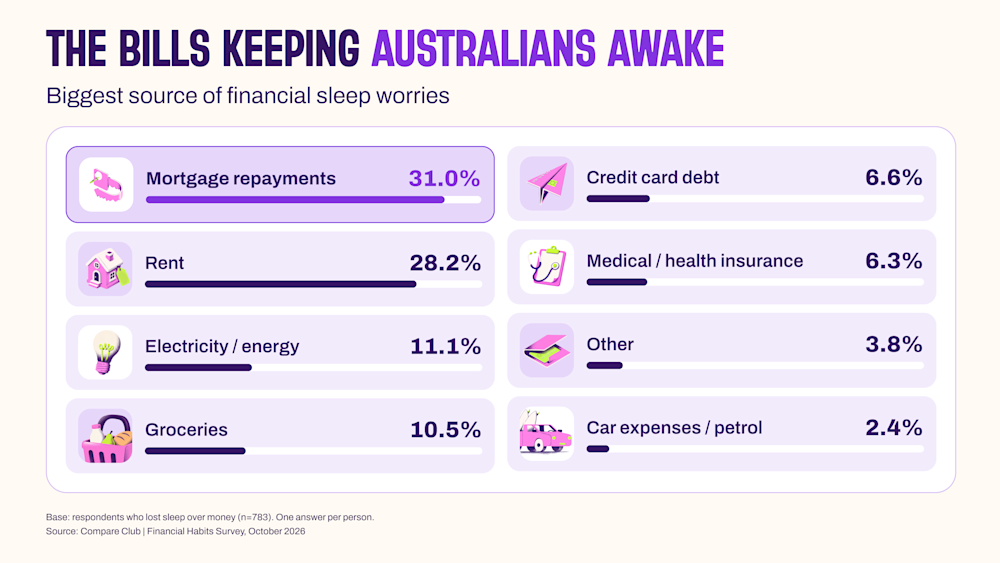
Mortgage repayments and rent together account for 59.3% of the main expenses nominated by respondents who have lost sleep over money.
While housing dominates, everyday essentials such as energy and groceries are also contributing to financial anxiety.
"These are not extravagant purchases or luxury items keeping Australians awake," Browne says. "They're the essentials. The roof over their heads, the electricity bill and the cost of putting food on the table.
"When people are lying awake worrying about how they're going to pay for everyday necessities, it's a sign that household budgets are under significant pressure."
3. Financial stress is disrupting sleep and affecting mental wellbeing
The research reveals that money worries are not simply making it harder for Australians to fall asleep.
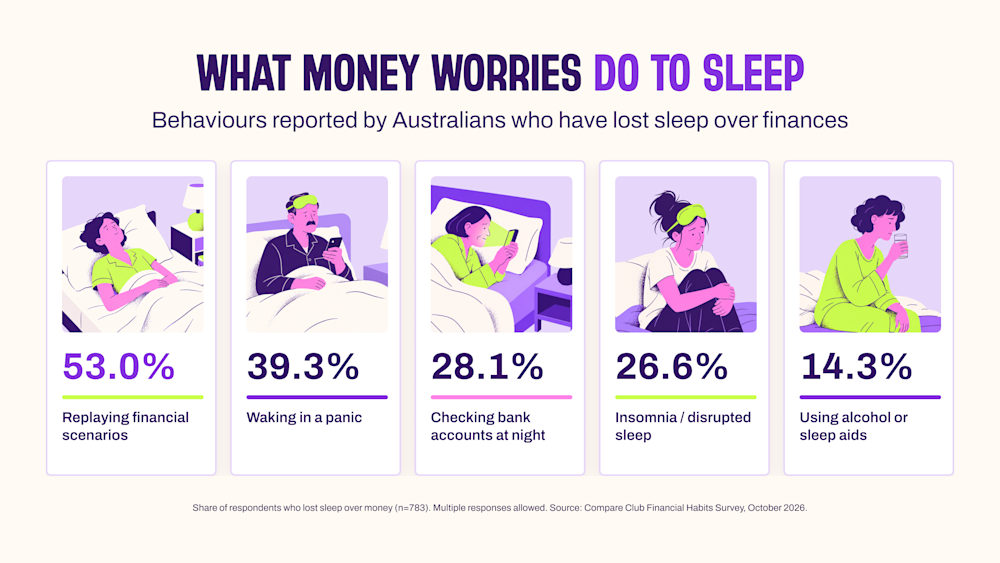
Among respondents who reported losing sleep over money, many described significant disruption to their sleep and nighttime behaviour.
How financial stress affects sleep
More than half of this group replay financial scenarios in their heads, while almost four in ten wake feeling panicked about money.
More than one in four report insomnia or disrupted sleep patterns, and 14.3% say they rely on alcohol or sleep aids to fall asleep.
The findings also show that 28.1% have checked their bank accounts in the middle of the night.
"Your bed should be somewhere you switch off, not somewhere you mentally calculate whether you can afford next week's groceries or mortgage repayment," Browne says.
"What's concerning is how many people report waking in a panic or struggling to switch off their financial worries.
"Money stress doesn't stay neatly contained in a bank statement. It follows people to work, into their relationships and into bed at night."
The impact on mental health
Financial stress is also having a substantial reported impact on Australians' mental wellbeing.
When asked how financial stress had affected their mental health in the past year, respondents reported:
Reported impact | Percentage |
|---|---|
Made existing anxiety worse | 43.5% |
Made existing depression worse | 24.4% |
Now experiencing anxiety they didn't previously experience | 19.6% |
Now experiencing depression they didn't previously experience | 6.2% |
No reported impact on mental health | 27.5% |
Almost three-quarters of respondents selected at least one mental health impact, while 27.5% said financial stress had not affected their mental health.
These are self-reported experiences rather than clinical diagnoses, but the results demonstrate the close relationship respondents perceive between financial pressure and emotional wellbeing.
"People often talk about financial stress as though it's simply a matter of budgeting better," Browne says.
"But these findings show the issue can be much more complicated.
"When people are reporting worsening anxiety, depression and disrupted sleep, the consequences go well beyond dollars and cents."
4. Financial infidelity: Almost half admit lying about money
Money is also becoming a source of secrecy within Australian households.
Almost half of respondents (48.3%) admit they have lied to a partner, former partner or family member about money.
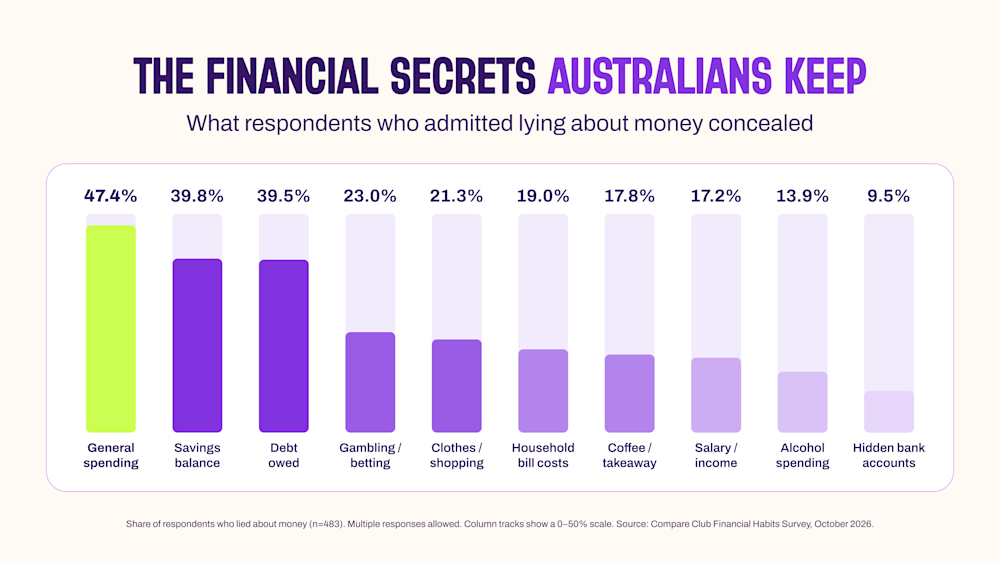
Among the 483 respondents who admitted financial dishonesty, the most common secrets involved everyday spending, savings and debt.
What Australians are lying about
General spending was the most common subject of financial dishonesty, followed closely by savings and debt.
Almost four in ten people who admitted lying about money had concealed how much debt they were in, while a similar proportion had misrepresented their savings.
Perhaps most concerning is the 23% who reported hiding spending on gambling or betting apps.
"There's a big difference between keeping a birthday present secret and hiding thousands of dollars in debt from someone you share your life with," Browne says.
"Financial dishonesty can be particularly damaging when couples are making major decisions together, such as buying a home, raising children or planning for retirement.
"Hidden debts and spending can leave one partner making financial decisions without having the full picture."
5. Secret shopping: Some Australians are hiding purchases worth thousands
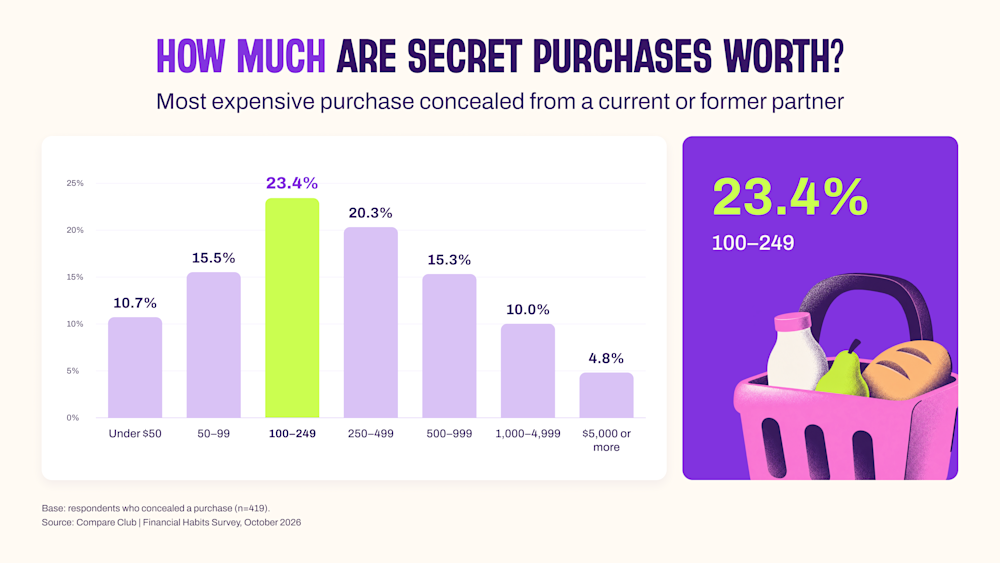
The research also found 41.9% of respondents have deliberately hidden a purchase from a current or former partner.
For many, the purchases were relatively modest. However, others admitted concealing much more expensive items.
Among the 419 respondents who had hidden a purchase, the most expensive concealed purchase was worth:
Almost one in three respondents who had hidden a purchase (30.1%) said their most expensive concealed purchase cost at least $500.
Nearly 15% admitted concealing a purchase worth $1,000 or more, including 20 respondents who reported hiding a purchase worth at least $5,000.
"Most people have probably bought something they didn't particularly want to explain to their partner," Browne says.
"But when purchases start running into the thousands of dollars, the potential impact on household finances becomes much more serious.
"Secret spending can create real problems when couples are already struggling to manage their bills or pay down debt."
6. Money arguments are damaging relationships
The consequences of financial pressure and secrecy can extend to relationships.
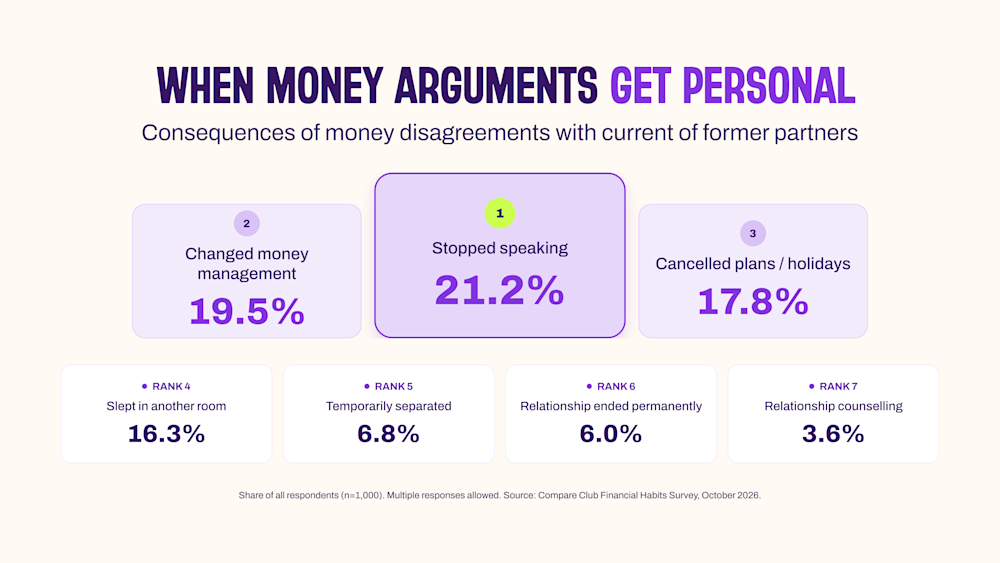
The survey asked respondents whether an argument about money had ever led to a range of outcomes with a current or former partner.
The consequences of money arguments
More than one in five respondents said a money argument had resulted in a period of not speaking to their partner.
Another 16.3% reported that one partner had slept in another room following a disagreement about money.
For some, the consequences were more serious, with 6.8% reporting a temporary separation and 6% saying a money argument had permanently ended a relationship.
However, not every outcome was negative. Almost one in five respondents (19.5%) said a money argument had led them to change how they managed their finances as a couple.
"Money can be an incredibly emotional subject, particularly when two people have very different attitudes to spending, saving or debt," Browne says.
"What's interesting is that some couples are using those difficult conversations to make positive changes to how they manage their money.
"Having an uncomfortable conversation about finances is often better than allowing secrecy or resentment to build."
7. Hidden debt versus hidden savings: What upsets Australians most?
Financial secrecy is not limited to spending or debt. Keeping savings hidden can also create problems in relationships.
The survey asked respondents which would upset them more if they discovered a current or former partner had deliberately concealed either $10,000 in debt or $10,000 in savings.
Response | Percentage |
|---|---|
Hidden $10,000 debt | 34.4% |
Hidden $10,000 savings | 10.0% |
Both equally upsetting | 35.1% |
Neither particularly upsetting | 10.4% |
Not sure | 10.1% |
More than one-third of respondents (35.1%) said both scenarios would be equally upsetting.
A further 34.4% said discovering $10,000 in hidden debt would be worse, compared with just 10% who would be more upset by hidden savings.
Combined, 69.5% said hidden debt would be at least as upsetting as hidden savings.
"There's an important distinction between financial privacy and financial dishonesty," Browne says.
"Everyone is entitled to some independence over their money, but deliberately hiding information that could affect a shared financial future can undermine trust.
"It's not always the amount of money that causes the biggest problem. Sometimes it's the fact that someone has deliberately kept it secret."
8. Avoiding the conversation: One in three have pretended to be asleep
One of the more surprising findings is the lengths some Australians have gone to avoid discussing money.
More than one-third of respondents (34.9%) admitted they had pretended to be asleep when a current or former partner wanted to discuss finances.
The result suggests that financial conversations can be so uncomfortable that some people would rather avoid them altogether.
"We've all had conversations we'd rather not have, but pretending to be asleep to avoid talking about money is a pretty extraordinary example," Browne says.
"The problem is that putting off those conversations can allow financial problems to grow.
"Whether it's credit card debt, a mortgage that's becoming harder to manage or simply disagreement about spending, the earlier people have an open conversation, the more options they're likely to have."
9. How Australians can start taking back control of their finances
While the survey reveals significant financial anxiety and avoidance, there are practical steps Australians can take to better understand and manage their household finances.
Compare Club recommends starting with the essentials.
1. Face your finances
Check your bank balances, review recent transactions and understand exactly what is coming in and going out each month.
Avoiding your accounts can make it harder to identify problems early or spot opportunities to save.
2. Review your biggest household bills
Energy, health insurance, life insurance and mortgage repayments can represent a significant proportion of household spending.
Reviewing these expenses regularly can help identify products that no longer suit your needs or are costing more than necessary.
3. Shop around rather than automatically renewing
Loyalty doesn't always mean receiving the best deal.
Comparing alternative providers and reviewing existing policies can uncover opportunities to reduce costs, although any savings will depend on individual circumstances and the cover or products selected.
4. Have honest conversations about money
For couples and families, discussing spending, savings, debt and financial priorities can help prevent misunderstandings.
Agreeing on shared goals and maintaining transparency around major financial commitments can also make it easier to plan ahead.
5. Seek support before problems become overwhelming
Australians experiencing financial hardship can contact their lender, insurer or service provider to discuss available hardship assistance.
Free financial counselling is also available through the National Debt Helpline on 1800 007 007.
Could switching household bills help?
Compare Club has calculated that households could potentially save around $4,000 annually by reviewing and switching across health insurance, life insurance, energy and their mortgage, depending on their circumstances.
These are potential savings across multiple products, not a guaranteed saving for every household.
"There's no magic solution to the cost-of-living pressures Australians are facing," Browne says.
"But there are things we can control, and one of them is making sure we're not paying more than we need to for essential household bills. You don't necessarily need to cut back on everything you enjoy to improve your finances.
"Sometimes the first step is simply checking whether you're getting a fair deal on the things you're already paying for."
Conclusion: The hidden cost of financial stress
Compare Club's Financial Habits Survey reveals that money worries are affecting Australians in ways that go far beyond household budgets.
Almost eight in ten respondents have lost sleep over money, nearly two-thirds have avoided checking their bank balance, and almost half admit having lied to a partner or family member about their finances.
The findings highlight the complex relationship between financial pressure, emotional wellbeing and personal relationships.
They also suggest that avoidance, secrecy and financial anxiety may be making it harder for some Australians to confront the problems they face.
"Money worries can make people feel isolated, embarrassed or overwhelmed, but the research shows just how common these experiences have become," Browne says. "If there's one thing I'd encourage Australians to do, it's to stop putting off looking at their finances.
"Knowing where you stand is the first step towards making changes, and even small improvements can make a meaningful difference. Nobody should be paying more than they need to simply because dealing with their bills feels too overwhelming."
About the research
The Compare Club Financial Habits Survey: Sleep, Secrets & Splurges was conducted in October 2026 among 1,000 Australian respondents.
The survey examined financial stress, sleep disruption, mental wellbeing, bank balance avoidance, financial secrecy, concealed purchases and relationship consequences.
Results are based on respondents' self-reported experiences. Some questions allowed multiple answers, so percentages may total more than 100%.
Unless otherwise indicated, percentages are calculated using the full sample of 1,000 respondents. Questions about the effects of losing sleep are based on 783 respondents, questions about financial dishonesty on 483 respondents, and questions about concealed purchase values on 419 respondents.
Figures have been rounded to one decimal place. The research identifies reported experiences and associations, rather than establishing clinical diagnoses or proving that financial stress caused particular health or relationship outcomes.
Media enquiries
For interviews or further information about the research, contact:
Kate Browne Head of Research, Compare Club
kate.browne@compareclub.com.au


