



Australians may be feeling the pressure of household bills, but new research suggests getting consumers to regularly shop around is still a challenge.
Compare Club research of 1,000 Australians found most people are prepared to switch providers and many have done so recently. However, rather than constantly monitoring the market for a better deal, the majority wait until something prompts them to act.
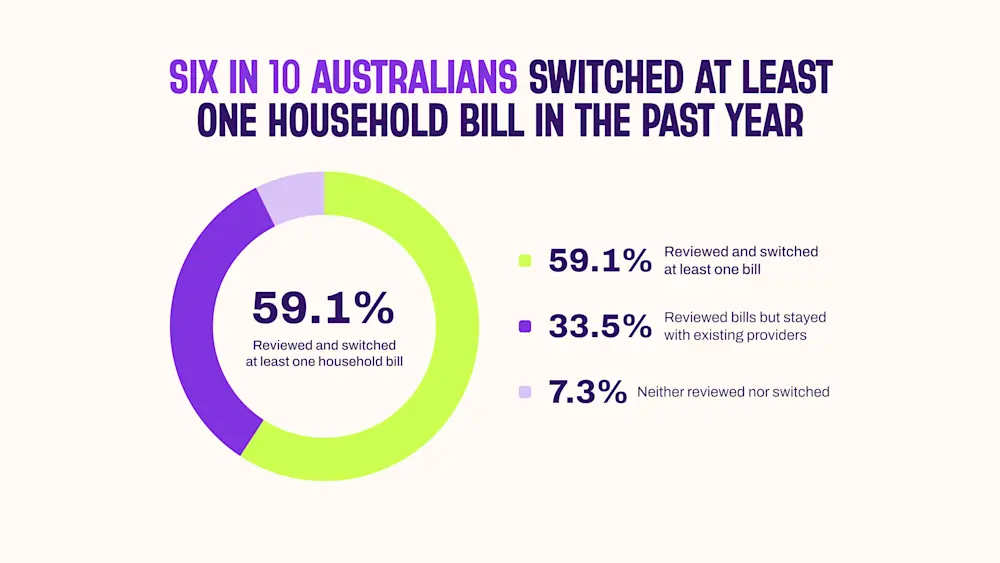
Almost six in 10 Australians (59.1%) said they had reviewed and switched at least one household bill in the past 12 months. Another 33.5% had reviewed their bills but ultimately stayed with their existing provider, while 7.3% had neither reviewed nor switched.
Switching behaviour also declines with age. More than two-thirds (68.8%) of Australians aged 25–34 had switched at least one bill in the previous year, compared with 63.8% of 35–44 year olds and 59.9% of 45–54 year olds. Among Australians aged 65 and over, this fell to 42.2%.
Most Australians aren't shopping around frequently
Despite the potential savings available from switching, Australians are much more likely to respond to a price rise than proactively search for a better deal.
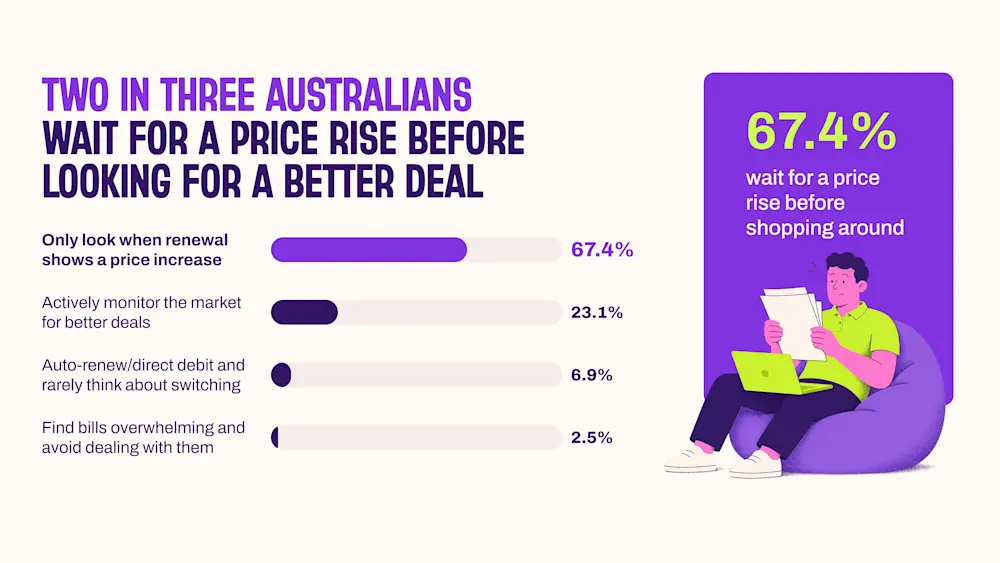
More than two-thirds (67.4%) said they only look at their options when a renewal notice shows a price increase.
Just 23.1% said they actively monitor the market and switch as soon as a better deal appears.
A further 6.9% have their bills on auto-renewal or direct debit and rarely think about changing them, while 2.5% find dealing with bills overwhelming and tend to avoid looking at them altogether.
The tendency to wait for a price rise becomes even more pronounced with age. More than eight in 10 (81.1%) Australians aged 65 and over only investigate their options after receiving a renewal notice showing a price increase.
This suggests that while Australians understand the benefits of shopping around, for many households switching remains a reactive rather than proactive financial behaviour.
The saving needs to justify the effort
Australians also put a clear dollar value on the hassle involved in switching.
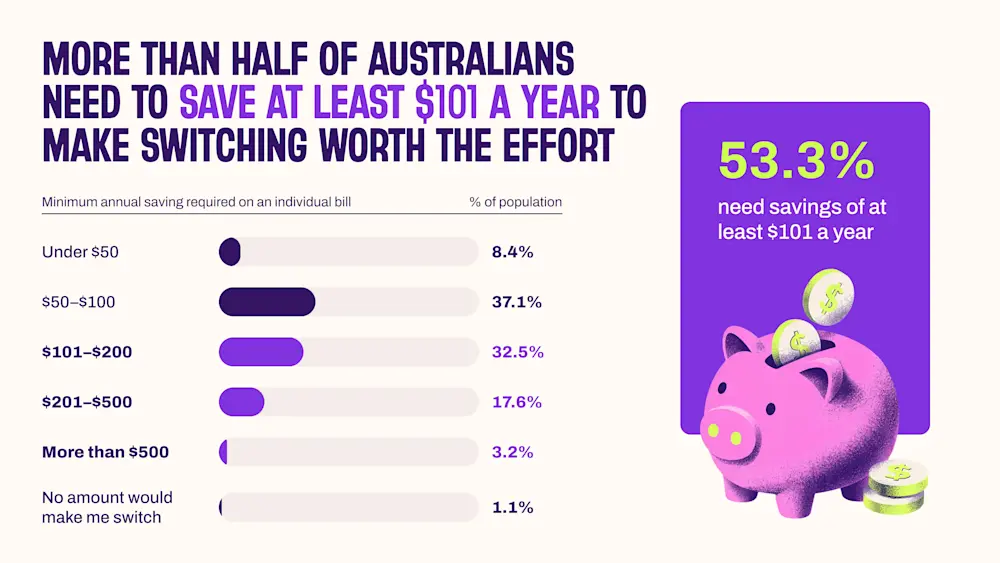
Only 8.4% would switch providers to save less than $50 a year on an individual bill.
The biggest group, 37.1%, said they would need to save between $50 and $100 a year to make switching worthwhile, while 32.5% would need savings of between $101 and $200.
Another 17.6% would require savings of $201–$500, while 3.2% would need more than $500 in annual savings before changing providers.
This means more than half of Australians (53.3%) need to see savings of at least $101 a year on a bill before they consider switching worth the effort.
It highlights an important part of consumer behaviour around household bills: finding a cheaper deal is not enough on its own. Consumers are also weighing the potential saving against the time, paperwork and effort required to make the change.
Time and effort remain significant barriers
When Australians were asked what stopped them reviewing or switching their bills, the largest group, 42.4%, said they were genuinely happy with their existing provider's price and service.
But for many others, the barrier was the work involved.
Almost one in five (18.4%) said comparing providers takes too much time and research.
Another 11.9% said the amount they could save wasn't worth the hassle, while 9.9% described cancelling an old provider and setting up a new one as too tedious.
A further 8.6% said the terms, features and contracts were too confusing to compare fairly, while 4.9% worried about reliability or hidden catches when moving to a new provider.
Together, these findings point to a significant "hassle factor" when it comes to managing household bills.
Consumers may know they can save money by shopping around, but the potential return needs to be large enough to justify the effort.
Younger Australians are doing more of the switching
There is also a clear generational difference in switching behaviour.
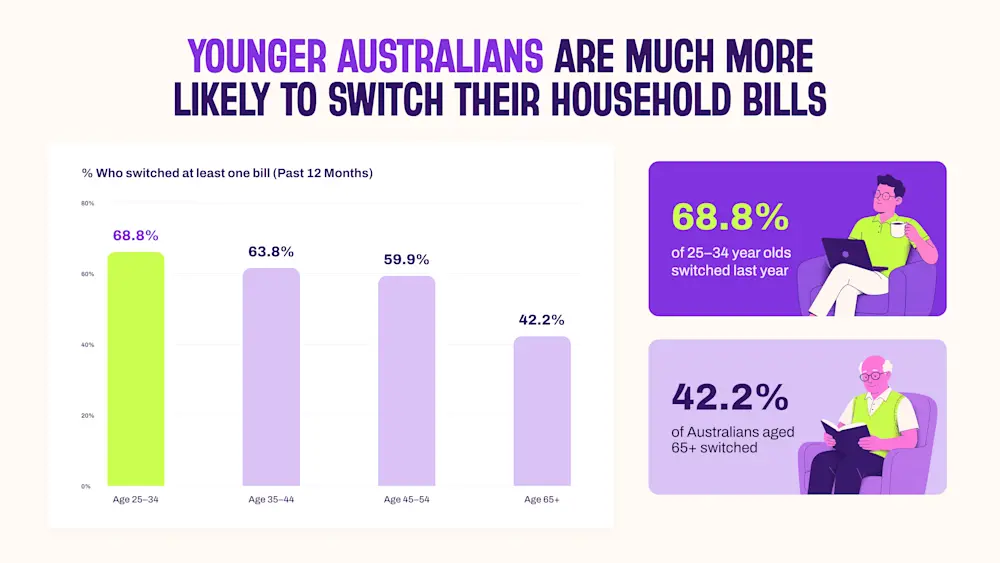
Australians aged 25–34 were the most likely age group to have reviewed and switched at least one household bill in the previous 12 months, at 68.8%.
That fell to 63.8% among 35–44 year olds and 59.9% among 45–54 year olds.
At the other end of the spectrum, just 42.2% of Australians aged 65 and over had switched a bill in the previous year.
Older Australians were also considerably more likely to wait for a renewal notice and price rise before looking at their options.
The findings suggest the challenge is not simply convincing Australians that switching can save money. It is making the process feel easy enough and worthwhile enough for them to act.
For households juggling multiple insurance policies, energy, internet, mobile and other regular expenses, reviewing every provider can quickly become another piece of financial admin.
The research shows Australians will switch, but they need a reason to do it.
For most, that trigger is a price increase. And once they start looking, the saving needs to be significant enough to compensate for the time and effort involved.
The opportunity is therefore not simply to tell consumers to shop around more often, but to make reviewing and switching household bills easier, faster and less confusing.


